Apple took the Siri AI dispute to von der Leyen’s Cabinet
The release establishes that Apple brought its Siri AI argument directly to President Ursula von der Leyen’s Cabinet and sought a call with Tim Cook. It also establishes what Apple alleged. It does not contain the Commission’s substantive answer.
The story in one minute
On 9 June 2026, after announcing Siri AI, Apple followed up with members of the President’s Cabinet. The email asked them to find time for a call between Tim Cook and von der Leyen and attached a paper cataloguing features Apple said had been delayed or withheld in the EU because of DMA interoperability requirements.
The most consequential passage concerns Siri AI. Apple says the Commission rejected all of its proposals for an EU launch and would require competing virtual assistants to receive equivalent access to iOS and iPadOS capabilities. Apple presents that as an unacceptable privacy and security risk.
That is a serious allegation made directly to the Commission. But it remains Apple’s allegation. The release does not show the proposals themselves, the Commission’s response, or an order prohibiting Apple from launching Siri AI.
Six documents, one evidence trail
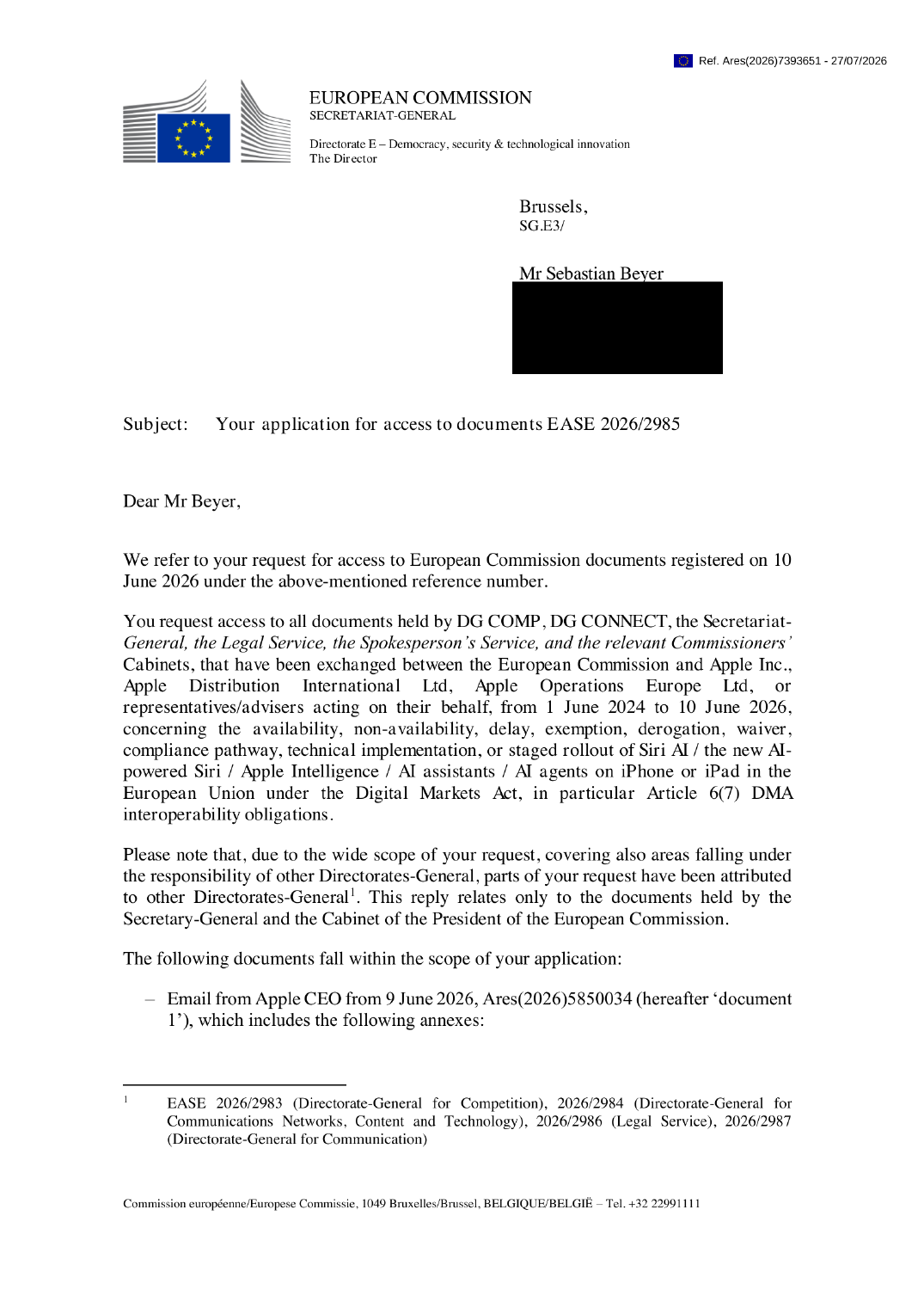 DecisionSecretariat-General partial grant
Five documents identified; later supplemented by the Cook letter.
Open PDF ↗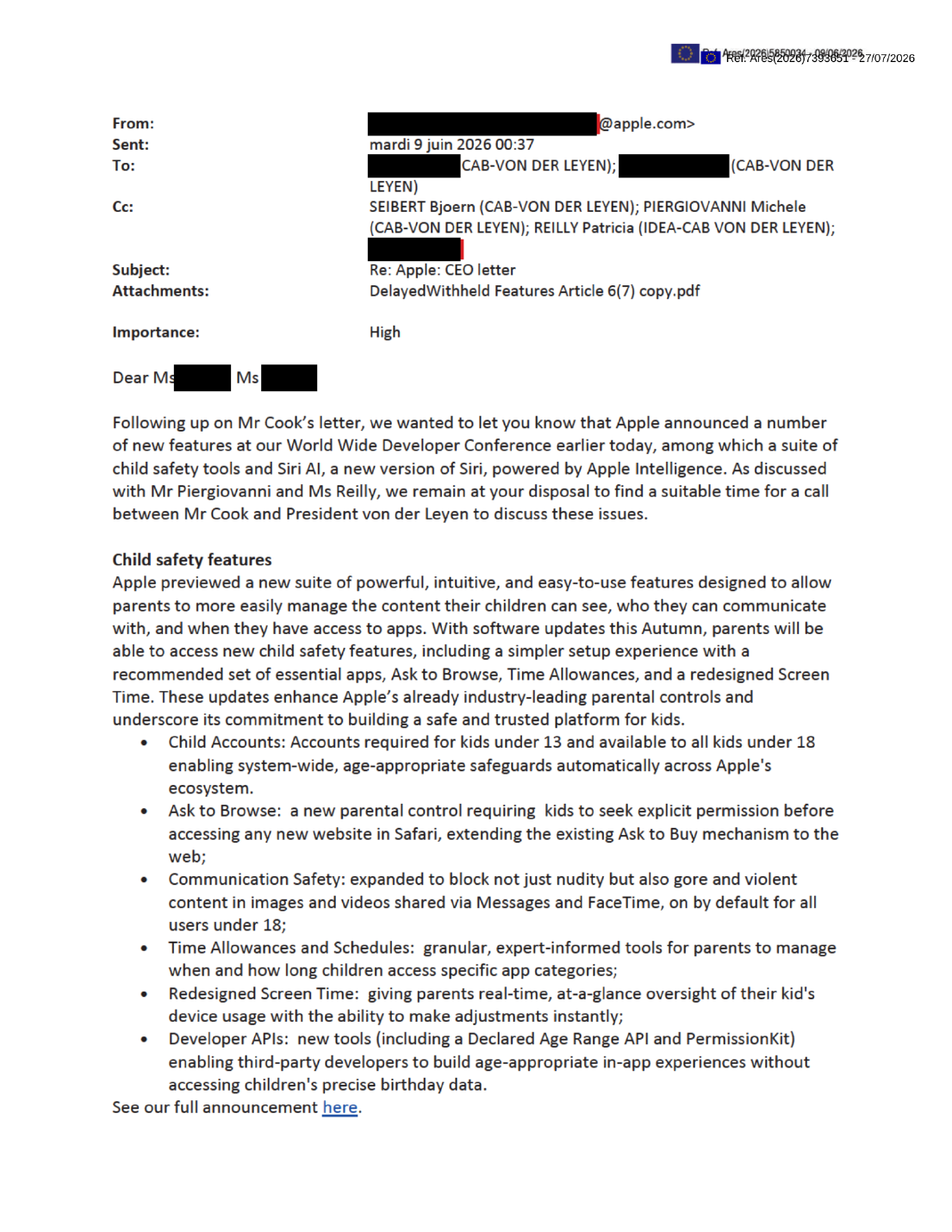 Document 1Apple email to the President’s Cabinet
Requests a Cook–von der Leyen call and introduces Apple’s Siri AI position.
Open PDF ↗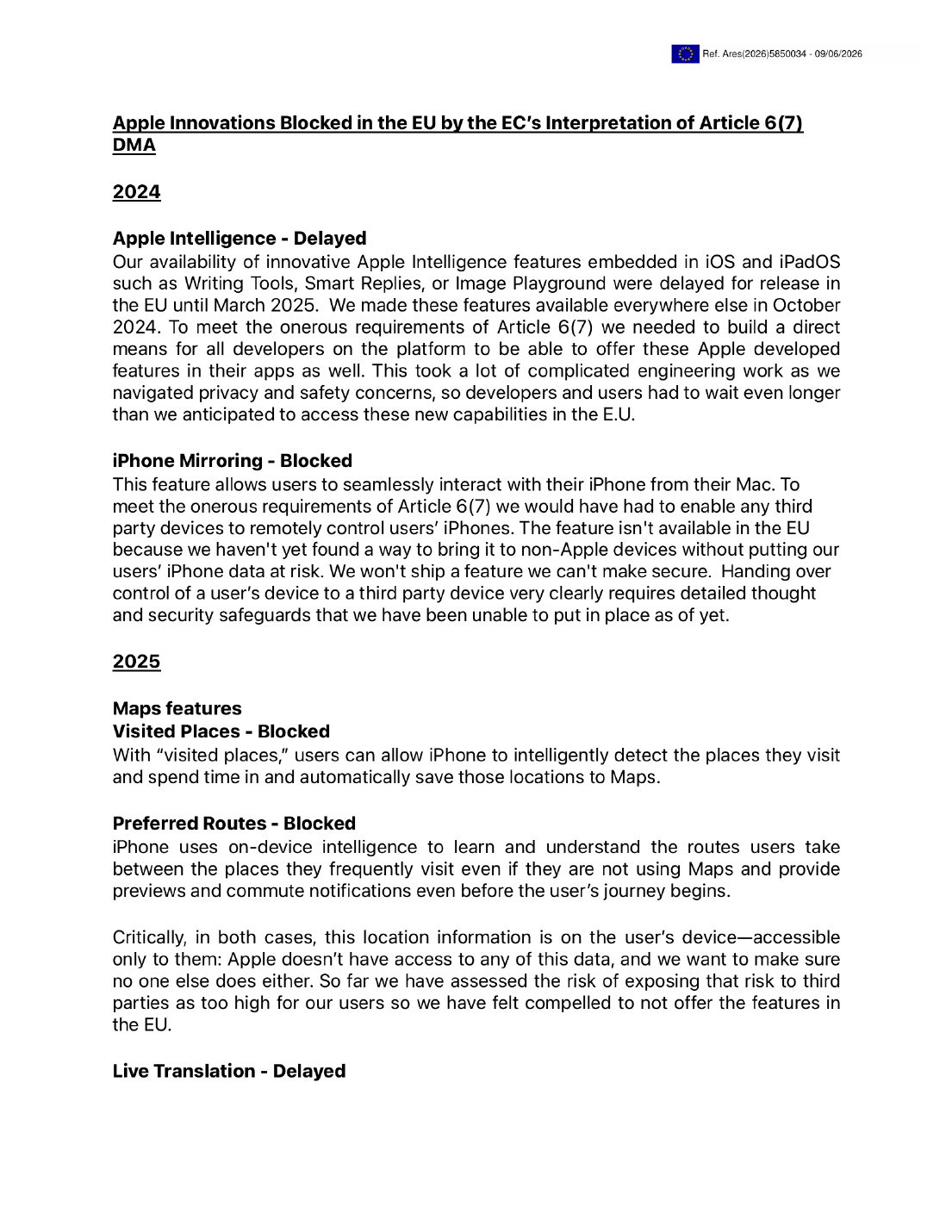 Document 1.1Apple position paper on blocked and delayed features
Sets out Apple’s claims about Siri AI and other DMA-related feature decisions.
Open PDF ↗ D2 Document 2 · 18 November 2025Apple meeting on the Commission’s digital agendaPublic consultations, protection of minors and upcoming Commission proposals.
Open PDF ↗ D3 Document 3 · 3 June 2026Apple meeting on protection of minors onlineChild-safety features, parental controls and screen-time tools; no Siri detail.
Open PDF ↗ D4 Document 4 · 20 January 2026Preparation for CEO contact with von der LeyenLists international cooperation, protection of minors and competition.
Open PDF ↗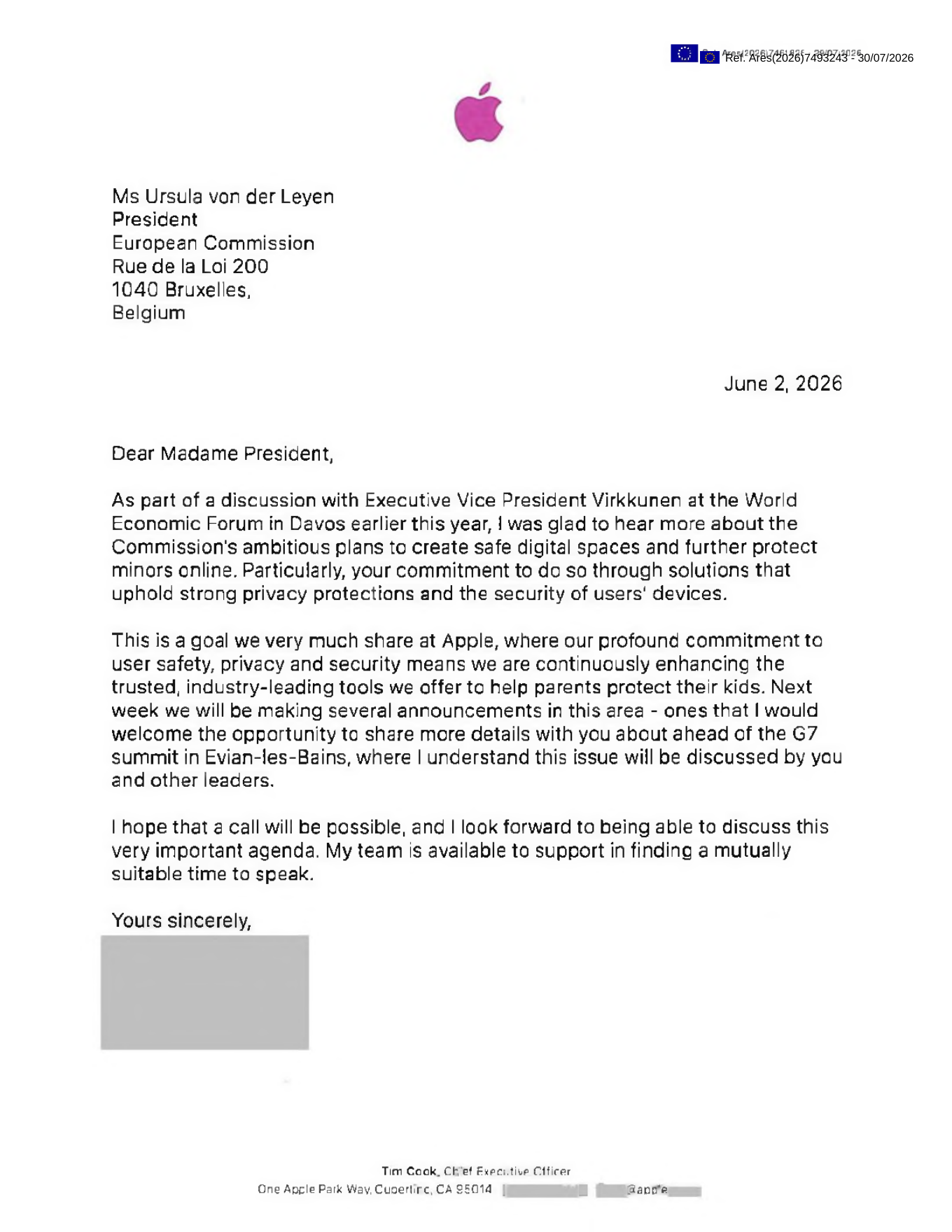 Additional document · 2 June 2026Tim Cook letter to President von der Leyen
Child safety, privacy and security; requests a call before the G7 summit. No Siri AI or DMA detail.
Open PDF ↗What the email adds
The email is more than a recycled press statement. It shows the path of escalation: Apple briefed Cabinet members, referred to an earlier Tim Cook letter, attached a focused Article 6(7) paper and asked for direct contact with the Commission President.
It also connects two conversations. Much of the email concerns Apple’s new child-safety tools, matching the 3 June meeting minutes. Siri AI then appears as the second major issue, with Apple pointing the Cabinet to its public announcement and the attached position paper.
What Apple says happened
Apple’s paper says its teams developed plans to bring Siri AI to EU users while protecting devices from risks associated with unmanaged third-party assistants. It says the Commission rejected every proposal and interpreted Article 6(7) as requiring any virtual assistant to receive the same access as Siri AI as soon as Apple launched.
Apple concludes that there is no current timeline for Siri AI on EU iPhones and iPads. It contrasts those devices with Mac and Vision Pro, which it says are not subject to the same DMA requirements.
What the documents establish
- Apple communicated this position to the President’s Cabinet.
- Apple sought a Cook–von der Leyen call.
- Apple said all of its Siri AI proposals had been rejected.
- The Cabinet had prior Apple contacts covering competition and digital policy.
What they do not establish
- What Apple’s proposals actually contained.
- Why the Commission did not accept them.
- That the Commission formally prohibited Siri AI.
- That Apple’s security claims were technically or legally correct.
Clarification resolved
The Secretariat-General supplied the previously referenced Cook letter on 30 July. It refers to a discussion with Executive Vice-President Virkkunen and seeks a call with President von der Leyen about child safety, privacy and security. It does not mention Siri AI, Apple Intelligence, DMA Article 6(7), or an EU launch request.
Why the withheld DG COMP files now matter even more
DG COMP has confirmed that it holds responsive material in DMA investigation files but refuses full and partial access. The Secretariat-General release demonstrates that Apple-originated material can be identified, described and disclosed with targeted personal data redactions.
More importantly, Apple’s allegation creates a question that cannot be answered by Apple’s paper alone: what did the Commission reject, and why? The confirmatory application against DG COMP’s blanket refusal will seek at least document categories, basic metadata and meaningful partial access.
The honest conclusion
The evidence now supports a narrower and more interesting story than either slogan: the Commission did not disclose a formal Siri AI ban; Apple did confront the Commission over an unresolved interoperability dispute and then chose not to launch on EU iPhones and iPads.
Whether that choice was a necessary response to genuine security risks or a refusal to give rival assistants equivalent access remains unresolved. The answer is likely in the documents that DG COMP has withheld. DG CONNECT has since said that it holds no additional responsive documents beyond DG COMP’s set.